
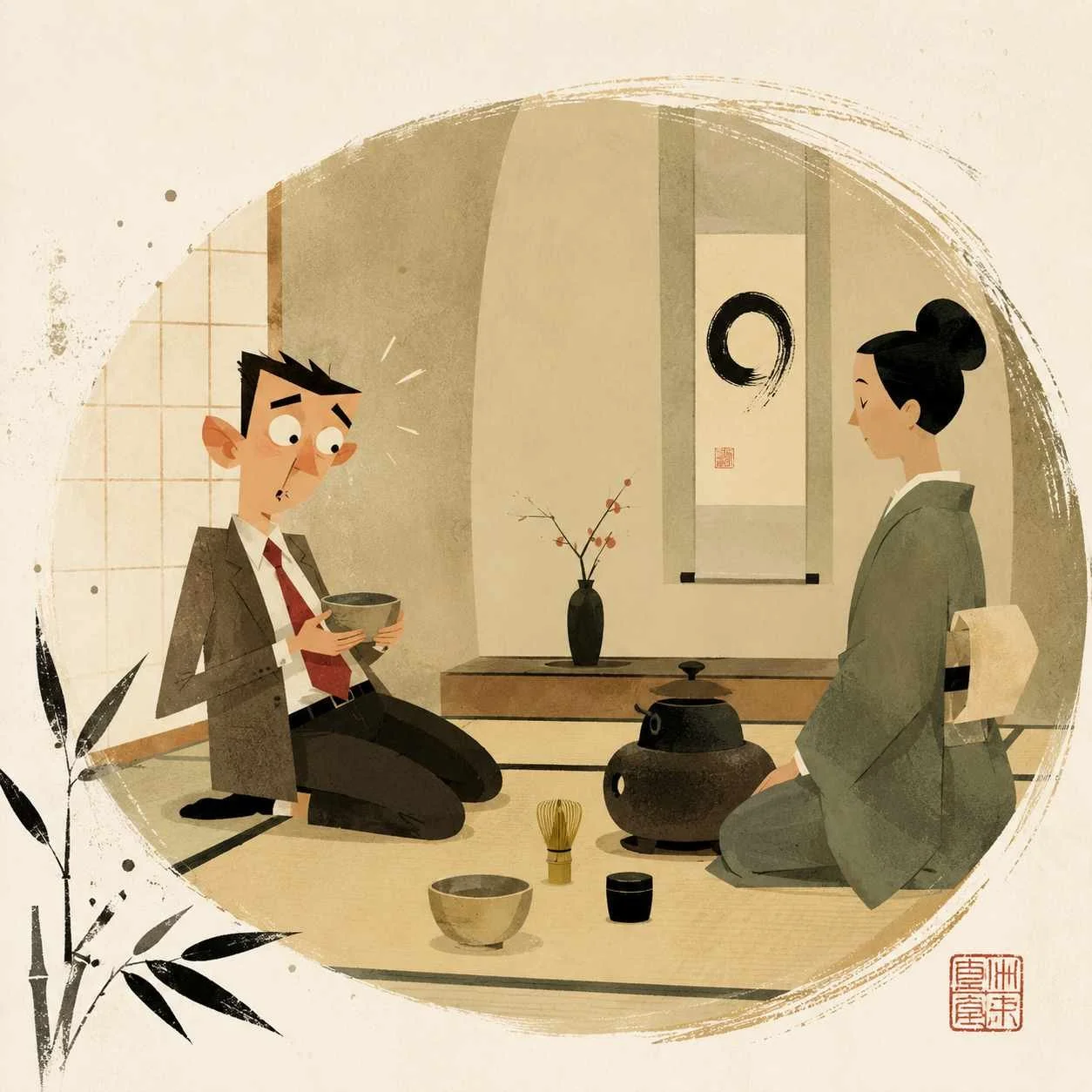
Mr. bean in Japan - humorous fiction
What If Mr. Bean Attended a Sacred Kyoto Tea Ceremony?
There are moments in life that seem almost too delicate for comedy.
A Japanese tea ceremony is one of them.
For centuries, the ritual has embodied harmony, respect, purity, and tranquility. Every gesture has meaning. Every silence has purpose. Every movement has been refined through generations until even placing a bowl on a tatami mat feels like poetry.
Now imagine Mr. Bean walking through the sliding shoji door.
Not to mock the ceremony.
Simply... because he is Mr. Bean.
The Arrival
The host bows.
The guests bow.
Mr. Bean attempts to bow while simultaneously trying to remove his shoes.
One shoe flies gracefully into the tokonoma alcove.
The flower arrangement, painstakingly selected that morning, trembles.
Nobody speaks.
The ceremony has not officially begun.
Yet somehow it already feels unforgettable.
Tatami Mathematics
Every guest kneels elegantly in seiza.
Mr. Bean lasts approximately eleven seconds.
His left foot disappears.
His right leg goes numb.
He experiments with seventeen increasingly creative sitting positions before accidentally inventing one never previously documented in Japanese history.
The host politely pretends not to notice.
The guest beside him quietly questions every decision that has led to this moment.
The Bowl
The tea bowl arrives.
Not merely a bowl.
An object shaped by generations of ceramic masters.
Its imperfections are intentional.
Its texture invites contemplation.
Mr. Bean turns it upside down searching for the manufacturer's logo.
He discovers a tiny fingerprint left by the potter centuries ago.
He attempts to wipe it off.
Matcha
The tea is finally prepared.
The bamboo whisk dances gently across the surface.
The foam forms perfectly.
The bowl is presented.
Mr. Bean assumes the whisk has been forgotten.
Being helpful, he begins stirring enthusiastically.
The foam disappears.
So does the collective emotional stability of everyone present.
Japanese Silence
One of Japan's greatest cultural achievements is its relationship with silence.
Silence here is not awkward.
It is generous.
It gives space to appreciation.
Reflection.
Presence.
Mr. Bean mistakes it for technical difficulties.
He smiles at everyone individually.
Nobody smiles back.
He smiles harder.
The Sweet
Before drinking the matcha, guests enjoy a traditional wagashi.
It is seasonal.
Handcrafted.
Delicately balanced.
Mr. Bean believes it is decorative soap.
Then changes his mind and eats three.
The Garden
After the ceremony, guests walk quietly through the garden.
The moss has been growing peacefully for decades.
The stone lantern has watched countless seasons pass.
A single maple leaf lands softly upon the pond.
Mr. Bean attempts to rescue what he believes is a stranded koi.
It is a reflection.
He apologizes to the water.
The Host
Throughout the afternoon, the tea master remains impossibly composed.
No sigh.
No frustration.
No visible panic.
Only another graceful bow.
Because true hospitality in Japan does not disappear when plans do.
It simply becomes quieter.
The Unexpected Lesson
Perhaps the remarkable thing is that, despite everything, the ceremony still succeeds.
Not because every movement was perfect.
Quite the opposite.
Because beneath every ritual lies a very human idea.
To slow down.
To be present.
To appreciate another person's company.
Even if that person has just mistaken a centuries-old tea bowl for a soup bowl.
TEMPTED TO SEE JAPAN DIFFERENTLY?

This tour deliberately avoids the city’s famous sites, focusing instead on serene temples, hidden gardens, and secret streets rich with untold stories. With an expert guide to illuminate the lesser-known treasures, you’ll connect deeply with Kyoto’s essence—savoring its quiet beauty and discovering a side of the city that eludes the crowds.
The price listed below is per group, not per person.

This private tour invites you to explore the city's innovative spirit, a journey through Tokyo's technological heart is an exploration of modern genius and human ambition.
Here, innovation takes form in spaces both tangible and ethereal—interactive exhibits, glimmering skyscrapers, and stories of engineering brilliance. More than a showcase of gadgets, this tour unveils Japan's profound dialogue between tradition and the future, inviting us to reflect on how technology shapes our shared destiny.
The price listed below is per group, not per person.