
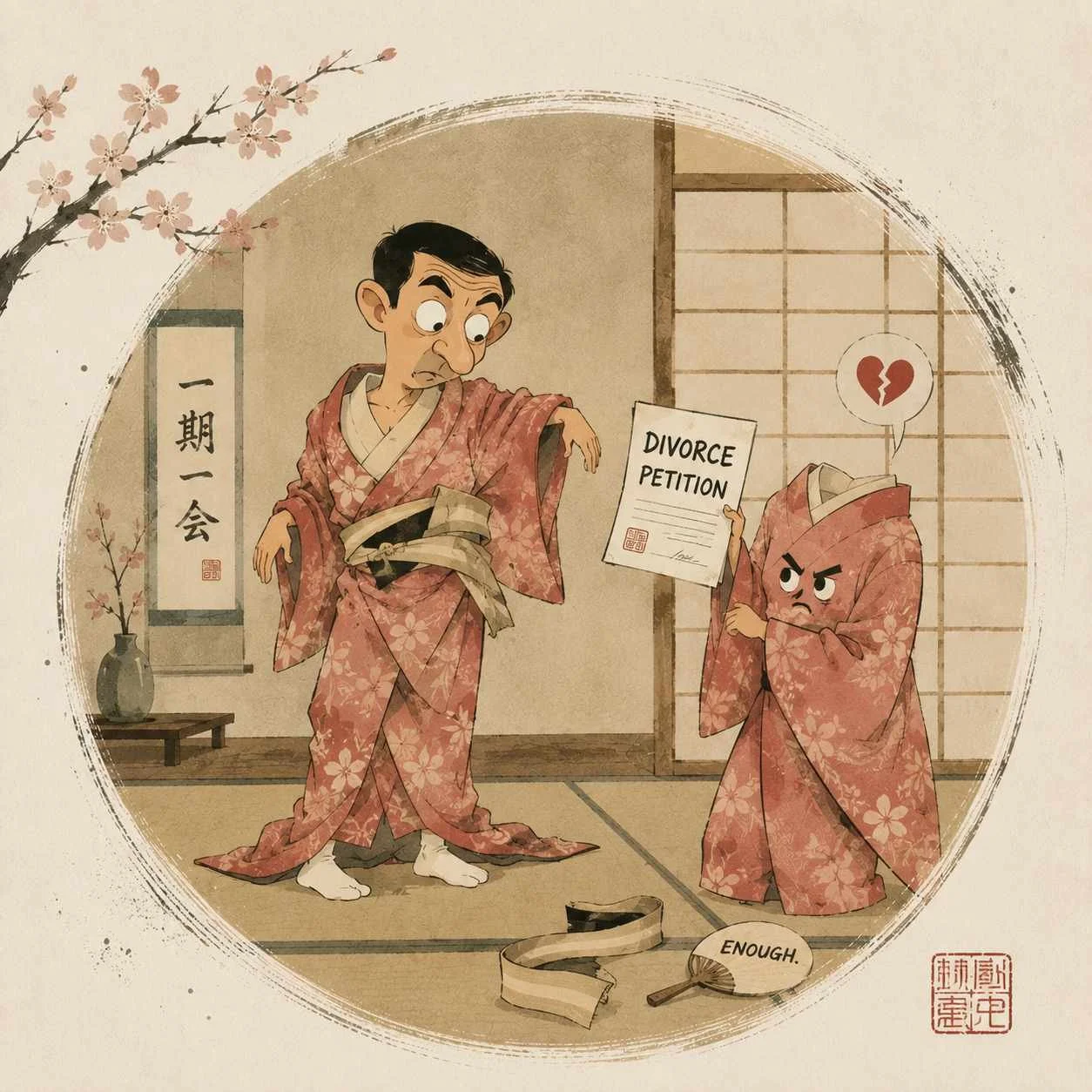
Mr. bean in Japan - humorous fiction
Mr. Bean Tried on a Kimono in Kyoto and the Kimono Has Filed for Divorce
This is a fictional comedy inspired by one of the world's most lovable clumsy characters.
There are garments.
There are works of art.
And then there is the Japanese kimono.
A kimono is not simply worn.
It is assembled.
Folded.
Wrapped.
Balanced.
Adjusted.
Respected.
It is the sartorial equivalent of Japanese architecture—everything exists for a reason.
Now imagine handing one to the most catastrophically awkward tourist ever imagined.
Somewhere in Kyoto, an elderly kimono dresser still wakes up at night and whispers,
"Not the left side over the right..."
The Dressing Begins
The assistant smiled warmly.
"Please raise your arms."
He raised one.
Then the other.
Then somehow both sleeves became occupied by the same arm.
No one knew how.
Least of all him.
Layer One
Perfect.
Layer Two.
Acceptable.
Layer Three.
Concerning.
Layer Four.
The kimono briefly resembled modern sculpture.
The Obi
The obi—the wide sash—is the masterpiece.
Tied correctly, it transforms the kimono into elegance itself.
Our visitor attempted to help.
Within seconds, the knot looked suspiciously like something sailors might use to anchor cruise ships.
Three assistants disappeared into another room to quietly reconsider their career choices.
Walking
Kimono walking is graceful.
Small steps.
Gentle posture.
Quiet confidence.
Our guest attempted Step One.
The hem disagreed.
The left sandal departed for Osaka.
The right sandal remained loyal to Kyoto.
The kimono entered negotiations.
The Photo Session
The photographer smiled.
"A little more natural."
Unfortunately, nothing occurring was natural.
The wind arrived.
One sleeve inflated like a sail.
The obi rotated ninety degrees.
A nearby tourist asked whether this was an avant-garde fashion show.
Tea Break
Still wearing the kimono, our hero attempted to sit.
The kimono objected.
He tried again.
The kimono objected more firmly.
Eventually both reached a compromise involving geometry that scientists have yet to explain.
Kyoto's Pigeons
Pigeons possess remarkable confidence.
One landed calmly on his shoulder.
Another inspected the obi.
A third appeared genuinely interested in becoming part of the outfit.
The kimono, already under considerable emotional strain, quietly contemplated retirement.
The Shopkeeper
The elderly shopkeeper watched patiently.
Years of experience had taught her many things.
She had helped thousands of visitors wear kimono beautifully.
She had solved impossible knots.
She had rescued sleeves from bicycle chains.
She had never before witnessed someone accidentally wear the obi as though preparing for mountain climbing.
She sighed.
Then smiled.
Because hospitality always wins.
The Farewell
At last the kimono was carefully removed.
Fold by fold.
Layer by layer.
The garment survived.
Barely.
Some claim they heard it whisper,
"Irreconcilable differences."
Others insist that was merely the rustling silk.
No official statement has ever been released.
The Real Beauty of Wearing a Kimono
The wonderful thing about kimono is that perfection is not expected from visitors.
The experience is not about looking Japanese.
It is about appreciating Japanese craftsmanship.
Every stitch reflects centuries of tradition.
Every pattern tells a seasonal story.
Every fold reminds us that beauty often lives in patience rather than speed.
Fortunately, experienced kimono dressers in Kyoto make the entire process wonderfully effortless.
Even if you're secretly convinced you would lose an argument with your sleeves.
TEMPTED TO SEE JAPAN DIFFERENTLY?

This tour deliberately avoids the city’s famous sites, focusing instead on serene temples, hidden gardens, and secret streets rich with untold stories. With an expert guide to illuminate the lesser-known treasures, you’ll connect deeply with Kyoto’s essence—savoring its quiet beauty and discovering a side of the city that eludes the crowds.
The price listed below is per group, not per person.

In the tranquil beauty of western Kyoto, nature and architecture intertwine to reveal powerful analogies about resilience and status. The Arashiyama Bamboo Grove stands as a living testament to perseverance. Its slender stalks, though flexible, grow tall and strong through steady, quiet endurance. The bamboo, bending with the wind yet never breaking, symbolizes how strength is found not in rigidity, but in the ability to adapt and persist—an enduring lesson for those who walk among them.
Nearby, the Golden Pavilion (Kinkaku-ji) gleams with a brilliant, gilded exterior, a reflection of the opulent aspirations of its original owners. Once a beacon of power and status, its radiant gold surfaces still speak of an era where wealth and influence were meant to be boldly displayed. The Golden Pavilion stands as a reminder that status is not just about achieving success, but about showcasing it to the world.
This tour offers a chance to explore the contrasts between quiet resilience and outward grandeur, offering insights into the ways in which both nature and architecture in Kyoto embody different dimensions of human ambition.
The price listed below is per group, not per person.